Brew methods
Espresso starter accessories for beginners
Start with a 0.1g scale, thin-needle WDT, and a magnetic dosing funnel—then add tools only when a real problem shows up.
Why beginners overbuy (and what actually moves the needle)
Start with accessories that make your routine measurable and repeatable. Assuming you already have an espresso machine and a suitable grinder, your first purchases should help you weigh coffee, distribute grounds, and keep them in the basket—not fill every space beside the machine.
A new accessory is an easy purchase when a shot tastes wrong. But without knowing your dry dose, beverage weight, and shot time, you cannot tell whether it helped. Keep those measurements consistent, taste the result, and change one variable at a time. Grind adjustment still matters more than collecting extra prep tools.
The practical takeaway from beginner discussions is often 0.1g scale + thin WDT + dosing funnel first—not a claim that every Reddit user agrees. A scale makes your recipe visible; thin-needle WDT helps distribute grounds; a funnel keeps prep contained. Buy for a specific job rather than copying someone else's entire counter setup.
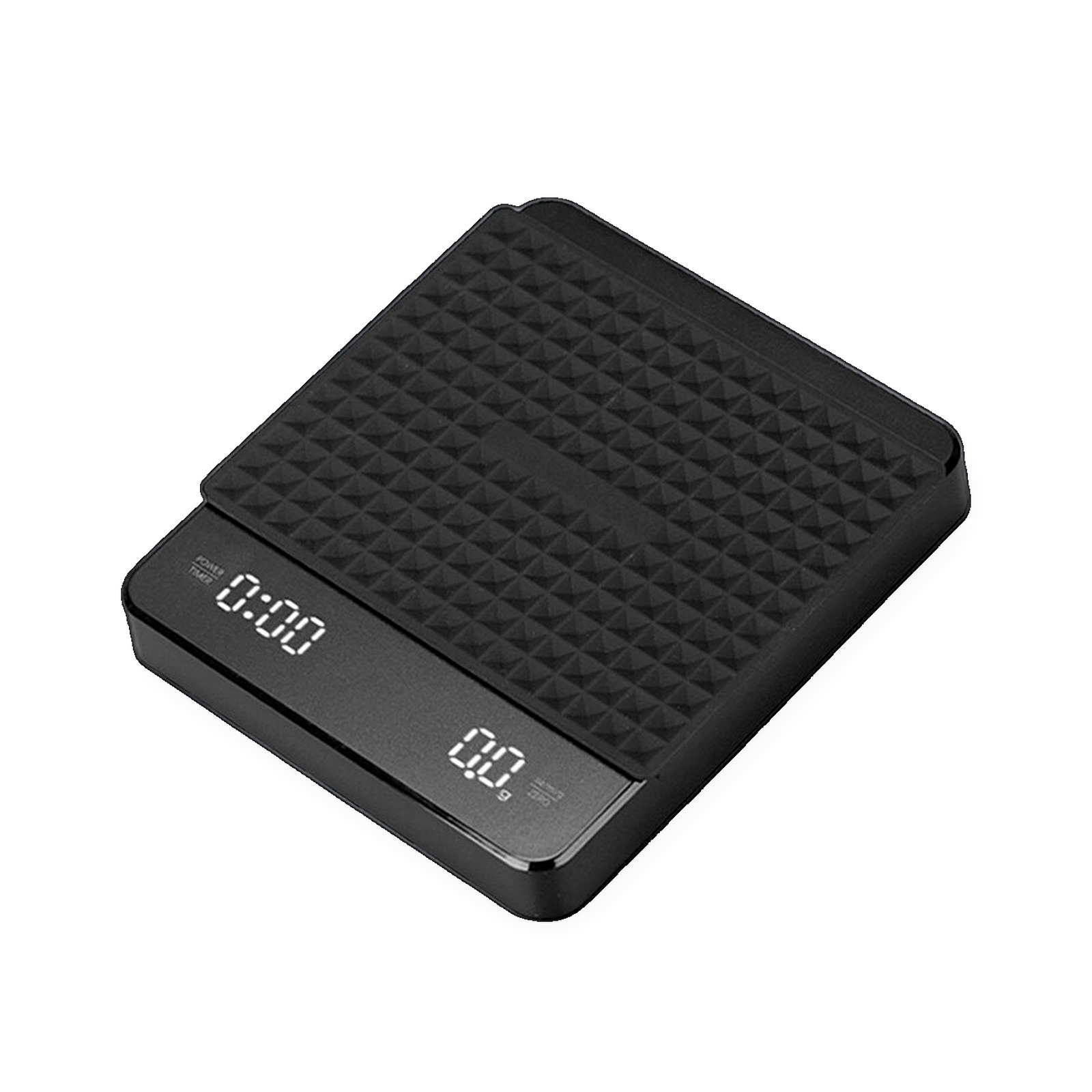
Priority 1: Coffee scale with timer (0.1g)
A scale with 0.1g resolution displays tenths of a gram, making it easier to repeat a dose than a whole-gram kitchen scale. Resolution is not a guarantee of laboratory accuracy, but it is useful for everyday espresso prep.
Weigh the grounds going into the basket and the espresso coming out. If your basket suits an 18g dose, 36g out is a reasonable starting point for a 1:2 brew ratio—not a universal recipe. Adjust for the coffee and your taste.
A built-in timer lets you track output weight and elapsed time together. Choose a consistent timing convention, such as starting when you activate the pump, and note it with your recipe. Time is a diagnostic clue, not a pass/fail target that overrides flavor.
The BurrPress coffee scale has 0.1g resolution, a timer, and USB recharging, with an individual price of about $29. See the coffee scale.
Before buying any scale, check clearance with your cup under the spouts. Compare the available space with the scale's listed dimensions; do not assume this model fits every machine. A compact-looking setup in a photo is not a fit measurement.
Buy for a specific job rather than copying someone else's entire counter setup.
Priority 2: WDT tool (thin needles)
WDT stands for Weiss Distribution Technique: using fine needles to break up clumps and distribute grounds before tamping. Work gently through the coffee, including below the surface, then finish with a reasonably level bed. Tamp afterward.
The goal is more even preparation, not a decorative pattern. WDT cannot rescue an unsuitable grind setting, and aggressive stirring that spills grounds makes your measured dose less repeatable.
Community discussions often mention roughly 0.3–0.35mm needles as a general starting point. That discussion is not the BurrPress specification or proof of one universally best diameter.
The confirmed BurrPress specification is 10 × 0.25mm needles made from 304 stainless steel. The WDT tool comes with a magnetic dosing funnel in a set priced at about $39. See the WDT + magnetic dosing funnel set.
Priority 3: Magnetic dosing funnel
A dosing funnel adds a temporary wall above the basket, helping contain grounds during grinding, transfer, and WDT. Magnetic attachment can help keep it seated on a compatible basket while you work. Check that it sits securely rather than assuming every basket will hold it equally well.
Remove the funnel before tamping unless the relevant equipment instructions explicitly support another workflow. Less spilled coffee means less cleanup and fewer unexplained changes to your dose.
Some users prefer a funnel that sits outside the basket opening so its lip does not occupy space inside the coffee bed. Others prioritize a secure fit and easy transfer. Neither preference establishes the geometry of this particular product: inspect the listing and fit information before buying.
The BurrPress set offers 51mm, 53mm, and 58mm options. Check your basket and machine documentation rather than guessing from the machine's appearance. Nominal diameter alone may not settle every rim-fit question.
Choose a size in the WDT + magnetic dosing funnel set. Priorities two and three are separate jobs covered by this one listed set, not a reason to buy duplicate funnels.
Buy later (after the first three)
These are not day-one must-buys. Add one when it solves a problem you have actually encountered.
A dosing cup collects grounds for weighing or transfer; a funnel contains grounds at the basket. They are not interchangeable. A cup may help if your grinder's output is awkward to direct into the portafilter, but adds another transfer step. The BurrPress dosing cup with lid is a 58mm aluminum cup priced at about $24. Verify compatibility with your setup; do not assume it shares the funnel set's size options.
Consider a spring calibrated tamper if repeating a comfortable, level tamp is difficult. First practice with your existing tamper and check its basket fit. A new tamper does not replace grind adjustment or even distribution.
A 12 oz milk frothing pitcher belongs on the list if you regularly make milk drinks. If you mostly drink straight espresso, wait. Choose pitcher capacity around your usual drink and allow room for the milk to expand.
A precision filter basket changes the basket you brew through; a bottomless portafilter lets you observe extraction from below. Neither is a shortcut to better espresso. Learn your current basket first, then check machine compatibility and basket capacity before changing hardware.
A simple order-of-purchase checklist
1. Measure: Get a 0.1g scale with a timer. Record dose, output, time, and taste.
2. Distribute: Add thin-needle WDT if clumps or uneven prep are a recurring issue.
3. Contain: Choose a correctly sized magnetic dosing funnel. The BurrPress WDT set covers both prep jobs.
4. Practice: Repeat one recipe before changing several tools or settings.
5. Solve the next problem: Add a cup for transfer, a tamper for your tamping workflow, or a pitcher for milk drinks.
The prices above describe individual listings, not a starter-kit price or a bundled offer. Check current product pages before purchasing.
What espresso accessories do beginners actually need first?
Start with a 0.1g coffee scale with a timer, then thin-needle WDT and a correctly fitted dosing funnel. This assumes you already have a suitable machine, grinder, basket, and tamper. If funds are limited, measure your recipe first and add prep tools as needed.
Is a WDT tool worth it for home espresso?
It can be, especially when your grounds arrive clumped or your distribution varies between shots. Use a gentle, repeatable technique before tamping. Compare results while keeping the recipe stable; WDT is a prep aid, not a guaranteed cure for every sour, bitter, or uneven shot.
Do I need a dosing cup and a dosing funnel?
Not necessarily. A cup catches and transfers grounds; a funnel helps keep them inside the basket during dosing and distribution. If you grind directly into the basket without trouble, you may not need a cup. Buy both only when each has a clear job.
Should I buy a precision basket or bottomless portafilter first?
Neither needs to come first in a beginner setup. Keep your existing basket while learning a repeatable recipe. Later, choose a basket if you have a specific basket-related goal, or a bottomless portafilter if you want a visual diagnostic aid. Confirm compatibility before either purchase.
What needle thickness should a beginner WDT have?
Community talk often points to roughly 0.3–0.35mm, but that is general guidance rather than a mandatory range. BurrPress's confirmed live specification is 0.25mm: 10 needles in 304 stainless steel. Do not confuse those two statements. Gentle technique and consistent coverage also matter.
Related guides & products
For the next practice session, read espresso prep with a hand grinder and grind size basics. Focus on one repeatable workflow before adding equipment.
Revisit the coffee scale, WDT + magnetic dosing funnel set, or dosing cup when you know which task needs help. For broader browsing, explore coffee grinder accessories—there is no need to buy everything at once.
Dial numbers are relative starting points. Keep a record of your beans, dose, setting, and taste to make the next adjustment easier.
Keep reading